
Data centres · 6 min read
Liquid-cooled data centres: what changes in BIM coordination?
Dexterous editorial team · 21 October 2026
A practical BIM coordination checklist for liquid cooling, coolant distribution units, pipework, maintenance access and staged data centre delivery.
Cooling is an interface decision
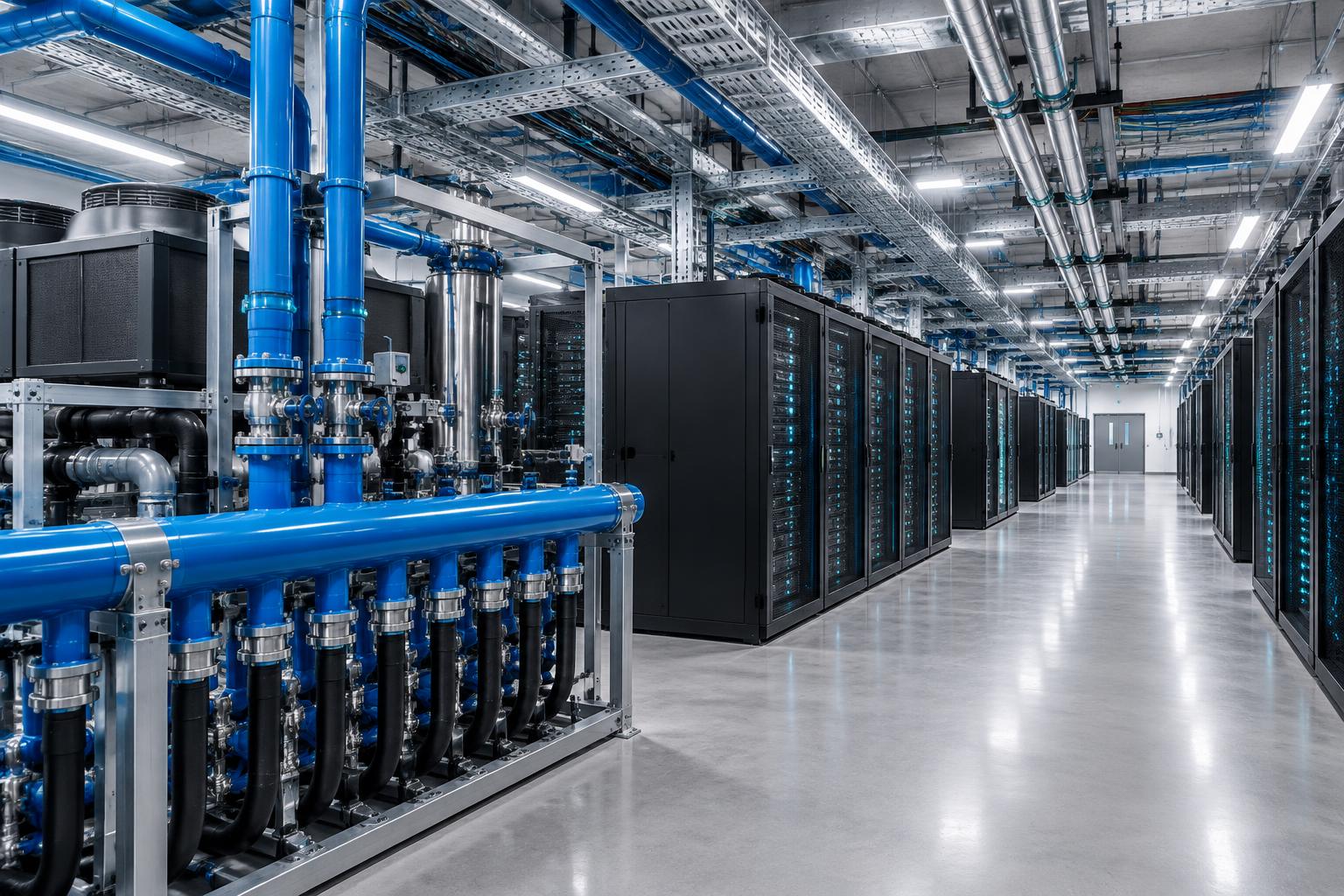
Air and liquid cooling are not interchangeable labels on the same model. The selected equipment and operating conditions determine which interfaces the design team must coordinate. Some facilities combine cooling approaches, so the model should describe the actual system rather than assume a single solution throughout.
Higher-density computing makes cooling architecture an important early conversation. However, a universal rack-density threshold or energy-saving claim is not a sound substitute for manufacturer requirements and project-specific engineering analysis.
Model beyond the pipe centreline
Where specified, coolant distribution units, manifolds and connection points introduce coordination needs at equipment and rack level. Include the agreed equipment dimensions, connection orientation and access zones. Confirm which flexible connections and vendor details belong in the design model and which arrive later.
Check installation routes, valve access, insulation allowances, drainage interfaces and replacement paths with the relevant designers. A geometrically clash-free pipe may still block a technician or make a unit impossible to replace.
Coordinate the transition to operations
Commissioning, isolation and phased energisation should inform the model review. Name systems consistently and align asset information with the operator’s handover requirements. Do not present a coordination model as a substitute for thermal analysis, hydraulic calculations or safety approval.
Questions to settle before modelling
Which cooling design has been approved? Who owns vendor geometry? What access envelopes must remain clear? How are building phases and future capacity represented? What is the agreed handover format? These questions reduce ambiguity before detailed MEP modelling begins.
Dexterous team experience includes air-cooled and liquid-cooled European hyperscale environments. Client identities remain confidential; this article offers general coordination guidance rather than disclosing a project design.
Editorial references
- US Department of Energy — Best Practices Guide for Energy-Efficient Data Center Design, 2024
- US Department of Energy — Liquid Cooling v. Air Cooling: Maui High Performance Computing Center evaluation
General guidance, not engineering approval. Apply project requirements and seek review from the appointed professionals.